
Top 10 AI Knowledge Management Platforms for 2026




AI knowledge management platforms have moved from passive document storage to active answer engines. The best ones in 2026 do three things well: they capture knowledge from the tools your team already uses, they govern it so answers stay accurate, and they surface it inside the workflow rather than behind a search box. This review ranks ten platforms that genuinely belong to the AI knowledge management category, explains how each was evaluated, and helps you match a platform to your team's real constraints.
How We Evaluated These Platforms
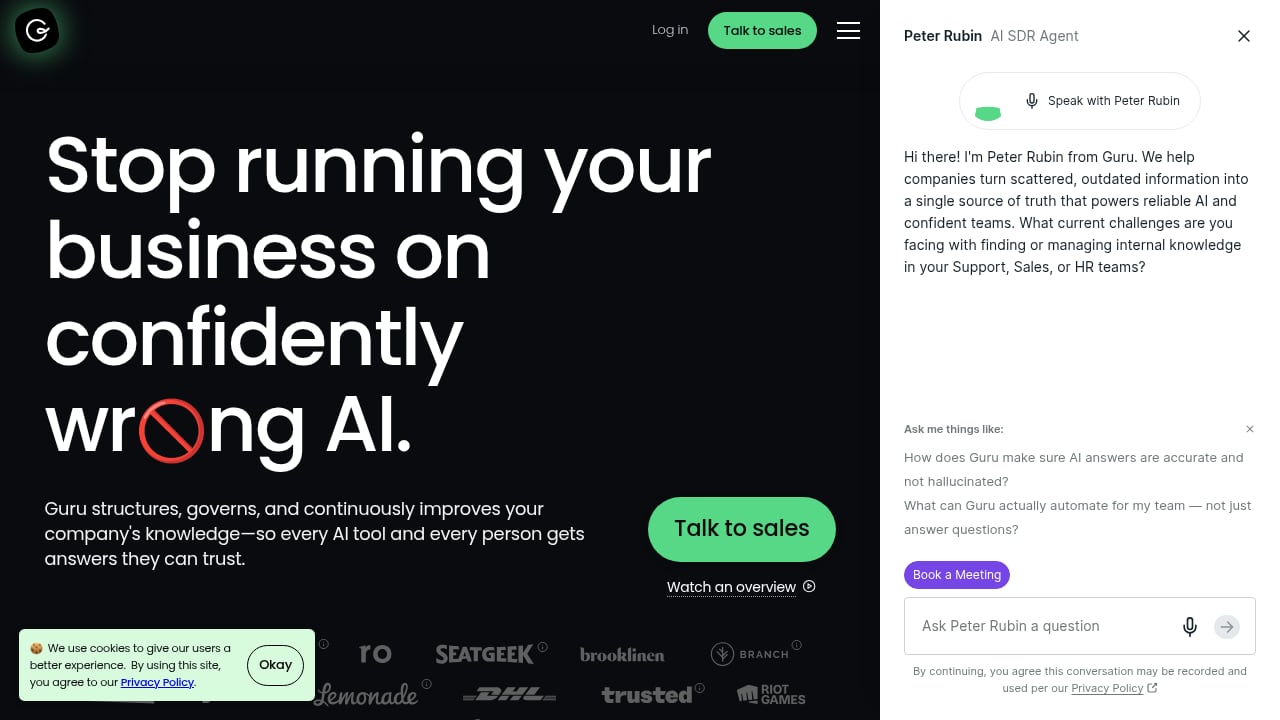
First viewport screenshot of The Governed Knowledge Layer for Enterprise AI.
Every platform on this list was assessed against six criteria, using vendor documentation, published pricing, independent reviews, and hands-on category research:
- AI retrieval quality: Does natural-language search return grounded answers, and does it cite or link to source content?
- Knowledge governance: Are there verification workflows, ownership assignments, and staleness detection to prevent confidently wrong answers?
- Capture and authoring: How easily can teams create, import, and structure content from existing tools like Slack, Google Drive, and ticketing systems?
- Workflow integration: Does knowledge appear where work happens (browser, chat, CRM, help desk) rather than in a separate destination?
- Deployment and compliance: What cloud, on-premise, or data-residency options exist, and which certifications are documented?
- Pricing transparency: Is there a free tier or trial, and are per-user costs predictable at scale?
Platforms were excluded if AI was a thin add-on to a document repository with no governance model, or if the product primarily serves a different category such as project management or HR operations.
The Top 10 AI Knowledge Management Platforms for 2026
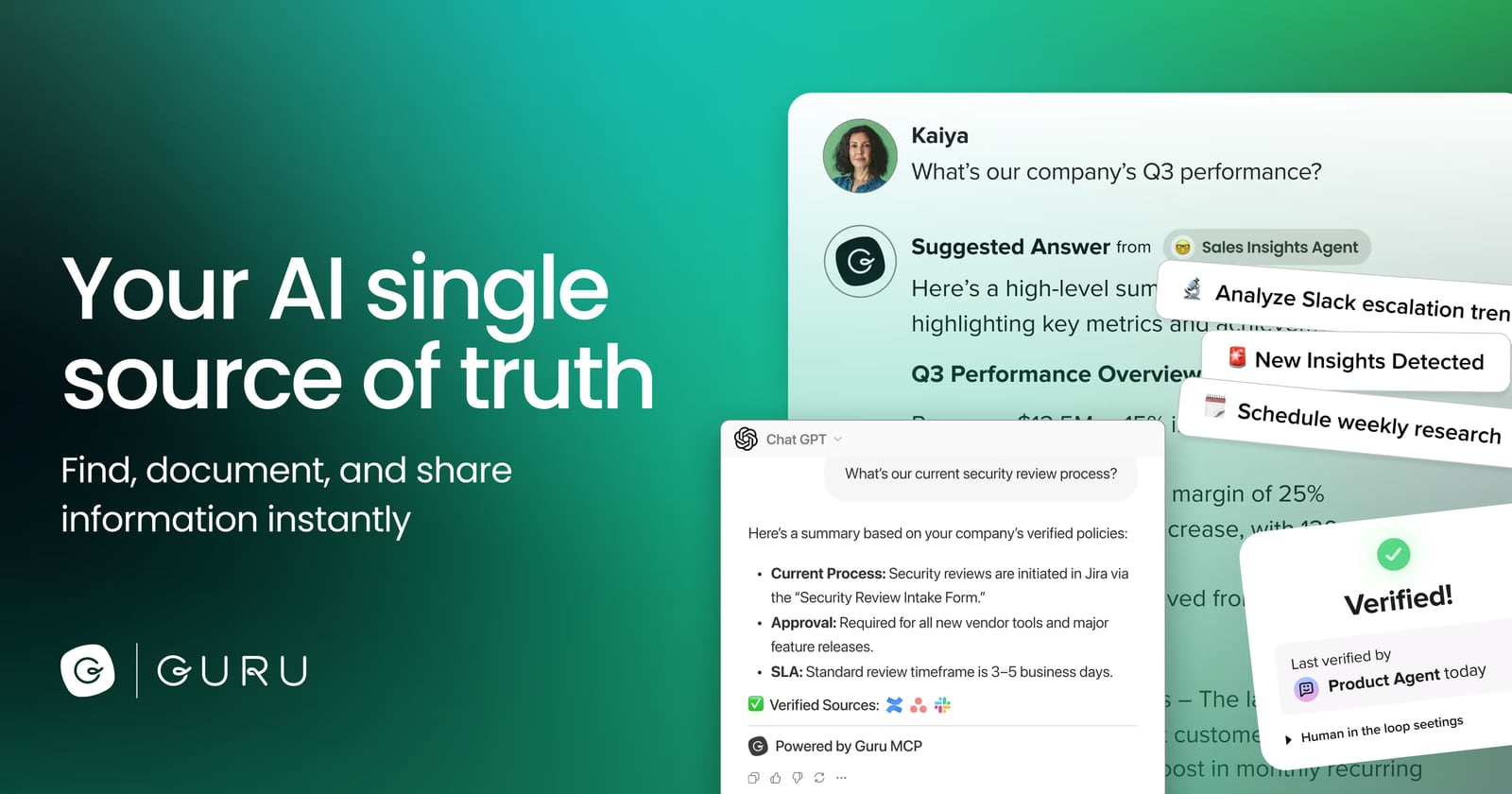
Guru product interface.
1. Guru — Best for Verified Answers in the Flow of Work
Guru structures, governs, and continuously improves organizational knowledge so that every AI answer can be trusted. Its browser extension and Slack and Teams integrations surface verified cards without pulling people out of their workflow, and its verification workflows assign content owners who must confirm accuracy on a schedule. That governance loop is the differentiator: most AI knowledge tools retrieve, but fewer enforce freshness.
Best for: Support, sales, and operations teams that need fast, trustworthy answers inside existing tools.
Considerations: Quote-based pricing; strongest value for teams with high answer volume rather than occasional wiki readers.
2. Document360 — Best for Product Documentation and Support Deflection
Document360 combines a knowledge base with AI search, an AI writing agent, and a support ticket deflector. Its Eddy AI assistant now includes citations in responses, and administrators can configure SAML, OIDC, and JWT from a unified SSO menu. Analytics on article performance help teams see which content actually reduces tickets.
Best for: SaaS, IT, and healthcare teams maintaining public help centers alongside internal documentation.
Considerations: Pricing on request; the platform is documentation-centric, so internal wiki use is secondary.
3. Glean — Best for Cross-System Enterprise Search
Glean indexes content across the SaaS stack—email, chat, documents, ticketing—and layers AI answers and assistants on top. Its strength is breadth: organizations with knowledge scattered across dozens of tools can make everything queryable without migrating content. Permissions are respected at the source, which matters for regulated industries.
Best for: Mid-size to large enterprises with fragmented knowledge and strong IT involvement.
Considerations: Quote-based enterprise pricing; value depends on how many connectors you actually deploy.
4. Confluence (Atlassian) — Best for Atlassian-Centric Teams
Confluence remains the default structured wiki for teams already using Jira. Atlassian Intelligence adds AI search, summarization, and content generation across pages and attached work items. The free tier and per-user pricing make it accessible, and the page-tree model enforces structure that AI retrieval benefits from.
Best for: Engineering and product organizations standardized on Atlassian.
Considerations: Governance is manual—without page owners and review cadences, content drifts stale.
5. Notion — Best for Flexible Team Wikis and Lightweight AI
Notion's all-in-one workspace combines docs, databases, and project views, with Notion AI providing search, summarization, and drafting. Its flexibility is unmatched for startups and cross-functional teams that want knowledge and work in one place. Databases can function as structured knowledge registries with properties for owner and review date.
Best for: Startups and small teams that value adaptability over rigid governance.
Considerations: Flexibility cuts both ways; without conventions, knowledge becomes hard to retrieve at scale.
6. Microsoft SharePoint with Viva — Best for Microsoft 365 Estates
For organizations already standardized on Microsoft 365, SharePoint plus Viva Topics and Copilot delivers AI-powered knowledge discovery inside Teams, Outlook, and Office. Content inherits existing permissions and compliance controls, which simplifies security review. Deployment can be cloud or on-premise.
Best for: Enterprises with mature Microsoft 365 governance.
Considerations: Setup and information architecture require significant administrative effort; AI value depends on content hygiene.
7. Bloomfire — Best for Searchable Knowledge Engagement
Bloomfire focuses on making knowledge findable and engaging, with AI-powered search, content recommendations, and analytics on what employees actually read and reuse. Its community features encourage experts to contribute answers, which helps capture tacit knowledge before it walks out the door.
Best for: Mid-market and enterprise teams that want knowledge sharing to feel social rather than archival.
Considerations: Quote-based pricing; less suited to public-facing documentation.
8. Slite — Best for Fast Doc Collaboration with AI
Slite pairs collaborative docs with AI-powered search and Q&A, and its verification features let teams mark content as reviewed. It is quick to adopt for small and remote teams that want a clean knowledge base without heavy administration. For a deeper look, see this Slite review for AI knowledge base buyers.
Best for: SMBs and remote-first teams prioritizing speed of adoption.
Considerations: Per-member pricing adds up; advanced governance is lighter than enterprise-focused rivals.
9. Starmind — Best for Expert-Network Q&A at Scale
Starmind uses AI to route questions to the right expert and to build a searchable knowledge network from the answers. It is designed for large, expertise-driven organizations where much valuable knowledge lives in people's heads rather than documents. The AI learns who knows what and improves routing over time.
Best for: Large enterprises with deep specialist knowledge and high question volume.
Considerations: Quote-based pricing; requires cultural buy-in to answering colleague questions.
10. Knowmax — Best for Customer Support Knowledge Workflows
Knowmax specializes in decision-tree and process guidance for customer support teams, layering AI search and assistance on top of structured workflows. It is particularly strong in contact centers where agents need step-by-step guidance rather than free-text articles.
Best for: Support organizations with complex, process-heavy resolution flows.
Considerations: Pricing on request; narrower scope than general-purpose knowledge platforms.
Comparison at a Glance
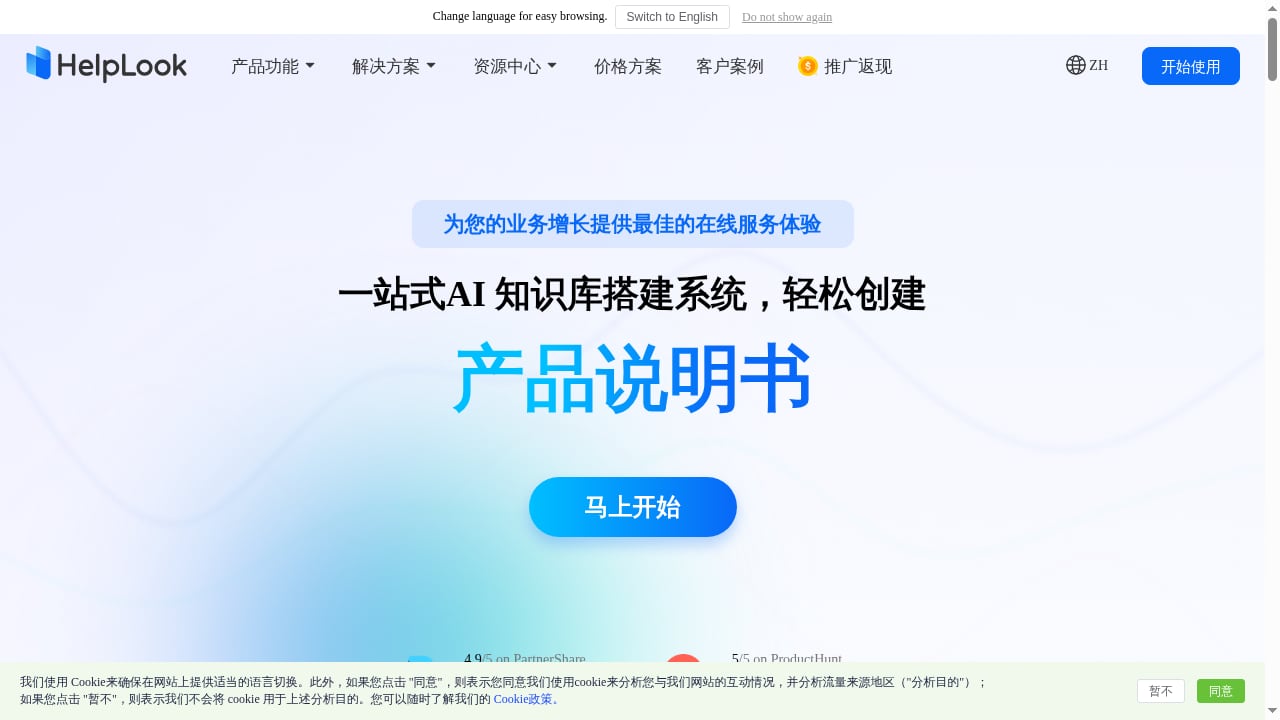
First viewport screenshot of www.helplook.net.
| Platform | Category Strength | Deployment | Best-Fit Buyer | Pricing Posture |
|---|---|---|---|---|
| Guru | Verified answers in workflow | Cloud | Support, sales, ops | Quote-based |
| Document360 | Product docs and deflection | Cloud | SaaS and support teams | Quote-based |
| Glean | Cross-system AI search | Cloud | Fragmented enterprises | Quote-based |
| Confluence | Structured team wiki | Cloud | Atlassian shops | Free tier; per-user |
| Notion | Flexible workspace | Cloud | Startups, small teams | Freemium; per-user |
| SharePoint + Viva | Microsoft 365 knowledge | Cloud, on-prem | Microsoft estates | Included with M365 |
| Bloomfire | Knowledge engagement | Cloud | Mid-market, enterprise | Quote-based |
| Slite | Fast doc collaboration | Cloud | SMBs, remote teams | Trial; per-member |
| Starmind | Expert-network Q&A | Cloud | Large expert orgs | Quote-based |
| Knowmax | Support process guidance | Cloud | Contact centers | Quote-based |
How to Choose the Right Platform
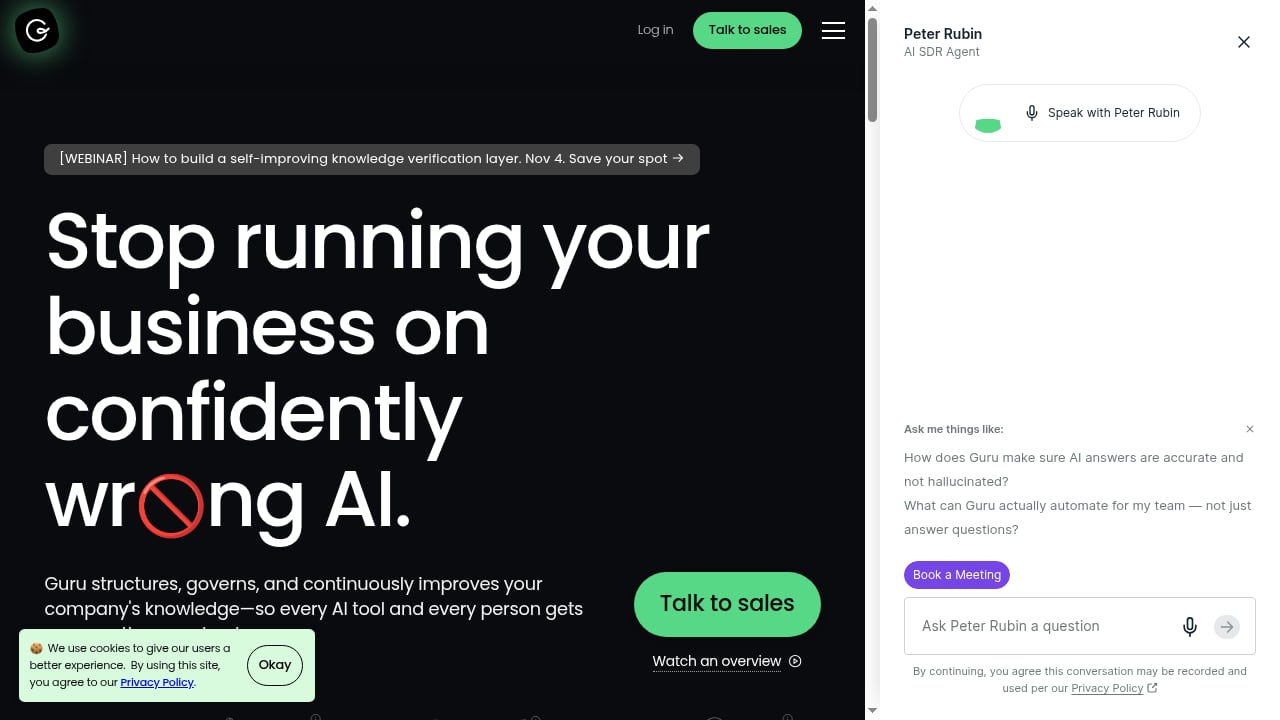
First viewport screenshot of www.getguru.com.
Start with where your knowledge lives, not with feature lists. If answers are scattered across email, chat, and ticketing, a cross-system search layer like Glean or an in-workflow platform like Guru will outperform a wiki. If your priority is public documentation and ticket deflection, Document360 or Knowmax fit better. If you are standardized on Microsoft 365 or Atlassian, the native options reduce integration overhead.
Second, decide how much governance you can sustain. AI answers are only as trustworthy as the content behind them, so verification workflows, content owners, and staleness alerts should be non-negotiable for customer-facing use cases. Third, model total cost at your expected seat count, including implementation effort—quote-based platforms often hide the real cost in onboarding and connector configuration.
Teams that also need a public help center or AI chatbot alongside internal knowledge management often pair a platform from this list with a dedicated knowledge base builder. HelpLook, for example, is an AI knowledge base and help center system for public-facing documentation and support chatbots, and it can complement an internal knowledge platform rather than replace one. If you are comparing support-focused options, this HelpLook vs ProProfs comparison and this HelpLook vs Botpress vs TeamSupport breakdown cover adjacent workflows. For teams documenting technical products, the help authoring and technical documentation software guide is a useful companion.
Practical Examples by Use Case
- Customer support: A SaaS team uses Guru cards verified weekly by product owners, with Document360 handling public help articles. Ticket deflection and agent answer speed are tracked separately.
- Enterprise search: A 2,000-person company deploys Glean across Slack, Drive, and Jira so employees can ask questions in natural language without migrating content.
- Regulated industries: A financial services firm keeps SharePoint with Viva for data residency and compliance, and uses verification workflows to flag outdated policy pages.
- Expert-dependent organizations: A consulting firm uses Starmind to route questions to subject-matter experts and convert answers into reusable knowledge.
Related reading
- How to Use HelpLook with CrafterQ: Setup & Workflow - Connect HelpLook's AI knowledge base with CrafterQ's website agent to turn help content into conversational support. Step-by-step setup, examples, and tips.
Sources and further reading
- 10 Best Knowledge Management Software Tools (2026 Review) - The 10 best knowledge management software platforms for 2026, ranked with pricing: Guru, Notion, Confluence, SharePoint, Bloomfire, Starmind and AI tools.
- 10 Best AI Knowledge Management Software Reviewed in 2026 - Discover the top AI knowledge management software and find the best option for your team. Compare features, pros & cons, prices, and more in my complete guide.
- AI knowledge base: 10 best tools & complete guide (2026) - An AI knowledge base uses generative AI to create, organize, and surface accurate information. Learn how it works, key features, benefits, and the best AI knowledge base software for 2026.
Frequently Asked Questions
What is an AI knowledge management platform?
It is software that stores organizational knowledge and uses AI—natural-language processing, retrieval-augmented generation, and often AI agents—to surface accurate answers on demand. Unlike a traditional wiki, it emphasizes retrieval and governance over passive storage.
How is this different from an AI knowledge base?
The terms overlap. An AI knowledge base often refers to the content repository and its search layer, while an AI knowledge management platform typically includes authoring, governance, integrations, and analytics around that repository. Many vendors use the terms interchangeably.
Which platform is best for small teams?
Notion and Slite are the fastest to adopt for small teams, with free or low-cost entry tiers. Confluence is a strong option if you already use Jira. Governance discipline matters more than platform choice at this scale.
Can I use more than one platform?
Yes, and many organizations do. A common pattern is an internal platform for employee knowledge plus a separate help center tool for customer-facing documentation. The key is to avoid duplicating content without clear ownership.
How do I measure whether an AI knowledge platform is working?
Track resolution-focused metrics: self-service ratio, ticket deflection, AI resolution rate, search success rate, content health (stale or unverified articles), and agent time saved. Vanity metrics like page views tell you little about answer quality.
Conclusion
The 2026 market rewards platforms that treat knowledge governance as a first-class feature, not an afterthought. Guru leads this list for verified answers in the flow of work, Document360 and Knowmax excel for support documentation, Glean solves cross-system search, and the Microsoft and Atlassian ecosystems offer strong native options. Choose based on where your knowledge lives, how much governance you can sustain, and whether you need internal, external, or both types of knowledge delivery—then measure success with resolution metrics rather than content volume.
;}.cls-2{fill:%230868f7;}.cls-3{fill:url(%23未命名的渐变_44);}.cls-4{fill:%23333;}%3c/style%3e%3clinearGradient%20id='未命名的渐变_8'%20x1='33.73'%20y1='100.61'%20x2='-0.03'%20y2='-1.06'%20gradientUnits='userSpaceOnUse'%3e%3cstop%20offset='0'%20stop-color='%237ae9fb'/%3e%3cstop%20offset='0.67'%20stop-color='%232b90f8'/%3e%3cstop%20offset='1'%20stop-color='%230868f7'/%3e%3c/linearGradient%3e%3clinearGradient%20id='未命名的渐变_44'%20x1='27.86'%20y1='18.67'%20x2='68.36'%20y2='22.22'%20gradientUnits='userSpaceOnUse'%3e%3cstop%20offset='0'%20stop-color='%235ac7f2'/%3e%3cstop%20offset='1'%20stop-color='%230868f7'/%3e%3c/linearGradient%3e%3c/defs%3e%3cpath%20class='cls-1'%20d='M29,28.74V81.91l-9.51-3.68v0L8.52,74A7.17,7.17,0,0,1,4,67.32V24.54A3.76,3.76,0,0,1,9.08,21Z'/%3e%3cpath%20class='cls-2'%20d='M68.09,78.07a13.15,13.15,0,0,1-17.9,12.06L29,81.91h0V28.74L50.19,37A13.17,13.17,0,0,0,68.08,25.3h0Z'/%3e%3cpath%20class='cls-3'%20d='M68.08,25.3a13.19,13.19,0,0,1-6.73,10.87A13.09,13.09,0,0,1,50.19,37L29,28.74V6A3.76,3.76,0,0,1,34.1,2.52l25.59,9.91A13.22,13.22,0,0,1,68.08,25.3Z'/%3e%3cpath%20class='cls-4'%20d='M129.06,81.76a4.33,4.33,0,0,1-3.19-1.31,4.4,4.4,0,0,1-1.31-3.24V56.86H97.65V77.21a4.36,4.36,0,0,1-1.35,3.2A4.68,4.68,0,0,1,93,81.76a4.32,4.32,0,0,1-3.19-1.31,4.37,4.37,0,0,1-1.32-3.24V27.27A4.58,4.58,0,0,1,89.83,24a4.59,4.59,0,0,1,7.82,3.27V48.15h26.91V27.27A4.58,4.58,0,0,1,125.91,24a4.59,4.59,0,0,1,7.82,3.27V77.21a4.37,4.37,0,0,1-1.36,3.2A4.65,4.65,0,0,1,129.06,81.76Z'/%3e%3cpath%20class='cls-4'%20d='M163.77,81.66c-6.57,0-11.76-1.92-15.44-5.7s-5.54-9.07-5.54-15.74a26.76,26.76,0,0,1,2.09-10.43,17.72,17.72,0,0,1,6.67-8.06,19.15,19.15,0,0,1,10.68-2.95,19,19,0,0,1,10.46,2.8,18.7,18.7,0,0,1,6.55,7.36,22.53,22.53,0,0,1,2.36,10.28A4.51,4.51,0,0,1,177,63.77H152.23a10.8,10.8,0,0,0,3.49,6.65c2,1.68,4.88,2.52,8.66,2.52a22.25,22.25,0,0,0,7.54-1.21c.74-.3,1.55-.67,2.37-1.07a3.75,3.75,0,0,1,1.84-.4,4.09,4.09,0,0,1,3,1.15,4,4,0,0,1,1.12,3,4.38,4.38,0,0,1-2.58,3.82,32.34,32.34,0,0,1-6.36,2.61A28.67,28.67,0,0,1,163.77,81.66ZM172.4,55.9a9.72,9.72,0,0,0-1.63-4.56A9.9,9.9,0,0,0,167,48a10.38,10.38,0,0,0-4.64-1.14,12,12,0,0,0-4.77,1.06,9.54,9.54,0,0,0-4.89,5.66,11.78,11.78,0,0,0-.51,2.3Z'/%3e%3cpath%20class='cls-4'%20d='M193,81.64a4.49,4.49,0,0,1-4.51-4.55V27.28A4.58,4.58,0,0,1,189.84,24a4.48,4.48,0,0,1,3.28-1.36A4.36,4.36,0,0,1,196.35,24a4.46,4.46,0,0,1,1.31,3.31V77.09a4.34,4.34,0,0,1-1.35,3.2A4.67,4.67,0,0,1,193,81.64Z'/%3e%3cpath%20class='cls-4'%20d='M263.79,81.71a5.7,5.7,0,0,1-4.2-1.74,5.76,5.76,0,0,1-1.73-4.19V27.37a4.58,4.58,0,0,1,1.35-3.27A4.59,4.59,0,0,1,267,27.37V72.53h24a4.58,4.58,0,0,1,3.27,7.82A4.66,4.66,0,0,1,291,81.71Z'/%3e%3cpath%20class='cls-4'%20d='M424.48,81.74a4.71,4.71,0,0,1-2.71-.88,5.43,5.43,0,0,1-1-1l-.07-.09-12.41-17-5.41,5v9.44a4.31,4.31,0,0,1-1.36,3.19,4.66,4.66,0,0,1-3.3,1.36A4.29,4.29,0,0,1,395,80.42a4.36,4.36,0,0,1-1.32-3.23V27.37A4.58,4.58,0,0,1,395,24.1a4.52,4.52,0,0,1,6.58.12,4.54,4.54,0,0,1,1.24,3.15V56.31l17.72-16.38.05,0a4.8,4.8,0,0,1,2.94-1.11,4.4,4.4,0,0,1,3.27,1.2,4.57,4.57,0,0,1,1.2,3.27,4.44,4.44,0,0,1-.77,2.33,7.45,7.45,0,0,1-1.43,1.65l-11,9.64,13.34,17.68a5,5,0,0,1,1,2.71,4.12,4.12,0,0,1-1.36,3.24A4.64,4.64,0,0,1,424.48,81.74Z'/%3e%3cpath%20class='cls-4'%20d='M317.93,81.76a21.5,21.5,0,1,1,21.17-21.5A21.37,21.37,0,0,1,317.93,81.76Zm0-34.1a12.61,12.61,0,1,0,12.42,12.6A12.52,12.52,0,0,0,317.93,47.66Z'/%3e%3cpath%20class='cls-4'%20d='M212.18,101.22a4.12,4.12,0,0,1-3.05-1.26,4.17,4.17,0,0,1-1.26-3.1V43.34a4.37,4.37,0,0,1,1.3-3.14,4.26,4.26,0,0,1,3.13-1.3,4.19,4.19,0,0,1,3.1,1.26,4.32,4.32,0,0,1,1.26,3.16,20.77,20.77,0,0,1,13-4.54,21.51,21.51,0,0,1,0,43,20.51,20.51,0,0,1-13-4.57V96.86a4.15,4.15,0,0,1-1.3,3.06A4.5,4.5,0,0,1,212.18,101.22Zm17.43-53.63c-6.23,0-12.93,4.11-12.93,12.72a12.73,12.73,0,0,0,25.46,0A12.71,12.71,0,0,0,229.61,47.59Z'/%3e%3cpath%20class='cls-4'%20d='M365.76,81.76a21.5,21.5,0,1,1,21.18-21.5A21.37,21.37,0,0,1,365.76,81.76Zm0-34.1a12.61,12.61,0,1,0,12.42,12.6A12.52,12.52,0,0,0,365.76,47.66Z'/%3e%3c/svg%3e)